Architecture · Service contract
Conservation and valorization of the Otomani archaeological site
Development of technical and economic documentation for the conservation, protection, and sustainable valorization of the Otomani archaeological site, a historic monument in Sălacea, Bihor County.
- Deadline
- Closed 12 days ago
- Location
- Sălacea, Bihor, Romania
- Declared value
- RON 296 000 (≈ EUR 55 387)
About the project
Development of technical and economic documentation for the conservation, protection, and sustainable valorization of the Otomani archaeological site, a historic monument in Sălacea, Bihor County. The project includes non-invasive interventions, controlled visitor infrastructure, and modern cultural interpretation tools to enhance archaeological heritage protection and tourism integration.
Scope of work
Elaboration of technical and economic documentation for the investment project, including feasibility studies (SF/DALI), technical design (DTAC/DTAD), and execution details (PT+DE). The scope covers obtaining necessary approvals, technical support during verification procedures, and compliance with heritage protection requirements for the archaeological site.
Deliverables
- Feasibility study (SF/DALI)
- Technical design documentation (DTAC/DTAD)
- Execution details (PT+DE)
- Supporting documents for approvals and authorizations
- Technical assistance during verification and approval procedures
Required services
- Architectural design services
- Technical engineering design for public works
- Project management and coordination
- Cost estimation and project planning
- Feasibility studies
Pelenoir assessment
The project primarily involves the conservation and valorization of the Otomani archaeological site, with a strong focus on architectural design for non-invasive interventions, visitor infrastructure, and cultural interpretation. Secondary disciplines include urban design and planning for tourism integration, landscape architecture for outdoor-environment enhancements, and engineering for technical compliance and infrastructure support. The scope is multidisciplinary, reflecting the need for coordinated design and planning efforts to address heritage protection and sustainable tourism development.
-
Architecture 50%
Architectural design for the conservation and valorization of the Otomani archaeological site, including non-invasive interventions, visitor infrastructure, and cultural interpretation tools to enhance heritage protection and tourism integration.
-
Urban and spatial planning for the integration of the archaeological site into the local tourism and community context, including masterplanning for controlled visitor access and public-realm enhancements.
-
Landscape design for the archaeological site, including open-space planning, planting, and outdoor-environment enhancements to support non-invasive conservation and visitor experience.
-
Engineering 15%
Technical engineering design for public works, including structural and civil engineering for visitor infrastructure, compliance with heritage protection requirements, and support for approvals and authorizations.
How to take part
Who can apply
- Minimum annual turnover of 590,000 RON for the last three financial years (2023–2025)
- Experience in designing projects for archaeological sites or historic monuments (at least one relevant contract)
- Specific professional experience for the project manager and architect in heritage conservation projects
- Compliance with exclusion grounds under Romanian public procurement law (Law no. 98/2016)
What to submit
- Documentul Unic de Achiziții European (DUAE)
- Technical and financial offer
- Proof of professional experience (contracts, reception documents, recommendations)
- Certificates for exclusion grounds (criminal record, tax compliance, etc.)
- Subcontracting agreements (if applicable)
Award criteria
- Price (40% weight)
- Professional experience of the project manager (15% weight)
- Professional experience of the architect (5% weight)
- Planning and organization of design activities (40% weight)
Source
Published on SEAP. Original title: Servicii de elaborare a documentațiilor tehnico-economice pentru obiectivul de investiții „De la Epoca Bronzului la comunitatea contemporană – conservarea și valorificarea sitului arheologic Otomani, comuna Sălacea, județul Bihor”, Cod SMIS: 365475.
Summary and assessment prepared by Pelenoir from the public notice (31 Oct 2026). The original notice and its documents are binding. Page updated 30 Oct 2026.
Keep exploring
Related tenders
Repair and refurbishment of the administrative building terrace at Suceava Depot
Modernization of University of Oradea Building C
Construction of the Natural Sciences Collection House in Brăila
Technical design and supervision for Romgaz building renovations
Military Maintenance and Training Facility at Câmpia Turzii Air Base
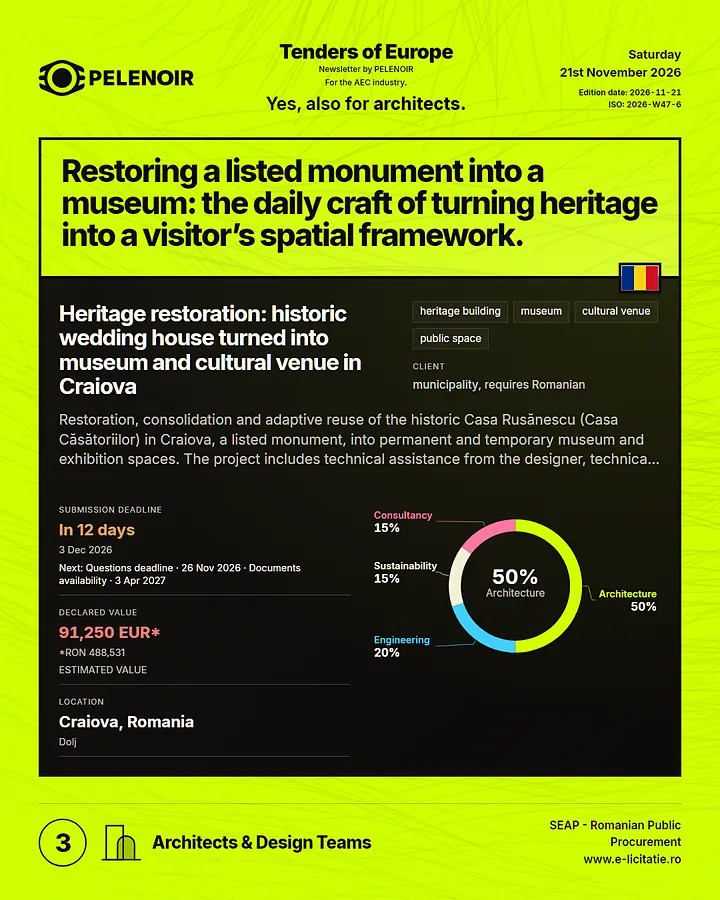
Heritage restoration: historic wedding house turned into museum and cultural venue in Craiova
Restoring a listed monument into a museum: the daily craft of turning heritage into a visitor’s spatial framework.
Pelenoir PAL
Find the tenders that fit your practice.
PAL reads every public notice and ranks the opportunities that match your portfolio, team and ambitions.